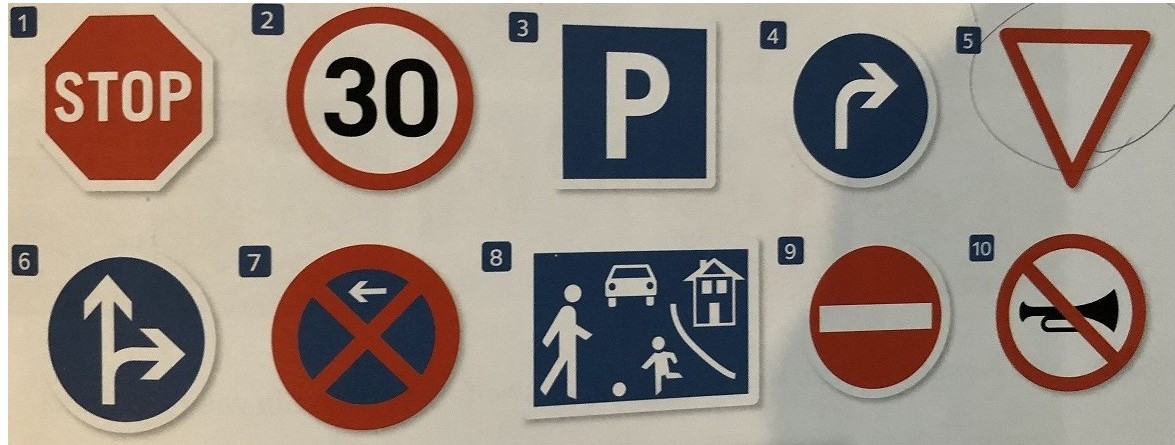
Introduction
Cars are an essential part of everyday life when living abroad, and Europe is no exception. Even in cities with well-developed public transportation systems, having a car can make a huge difference when traveling to the suburbs, doing grocery shopping, or taking trips. Your range of activities can expand dramatically when you have access to a car.
However, driving in a foreign country for the first time can be challenging because traffic rules and road customs may differ significantly from those in Japan. Having an international driving permit does not automatically mean that you are prepared to drive safely. Being legally allowed to drive and actually being able to drive safely are two completely different things. Following local traffic laws is essential, and “I didn’t know” is not an acceptable excuse.
When I first drove in Europe, I had a local person sit beside me and teach me the rules one by one while we actually drove on the roads. In this article, I will focus particularly on the differences from Japan that Japanese drivers are most likely to find confusing.
(You can find the portal page collecting all the articles on this blog here.)
(当ブログの記事をまとめたポータルページはここです)
(オンラインショップを始めてみました。是非こちらからご覧になってください。)
Amazon.co.jp
あなたと一緒に作る海外旅行【トラベル・スタンダード・ジャパン】

Speed Limits|What Town Signs Actually Mean
In many European countries, speed limits are clearly determined by whether you are inside or outside a built-up area.
In countries such as Austria and Germany, once you pass a sign displaying the name of a town, the maximum speed generally becomes 50 km/h even if there is no separate speed-limit sign. This is a very important point, and if you are unfamiliar with the system, it is surprisingly easy to unintentionally exceed the speed limit.
When I first saw these town-name signs, I simply thought, “So this must be the beginning of the town.” I had no idea that the sign itself also indicated a change in the applicable speed limit.
When leaving a town, you will see a sign showing the town name crossed out. Beyond that sign, the general speed limit on ordinary roads in Austria is typically 100 km/h.
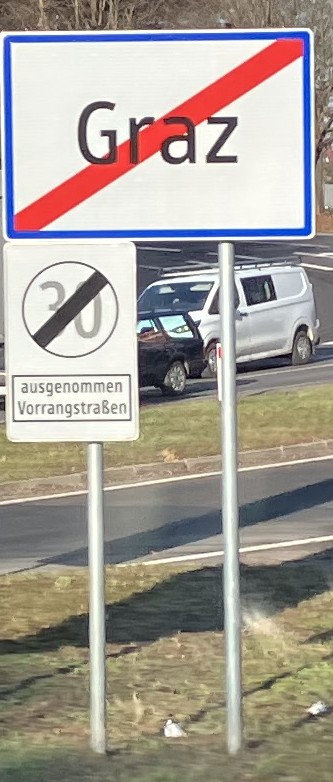
In cities such as Graz, you also need to be particularly careful because 30 km/h zones are widespread. This does not mean that the entire city has a 30 km/h limit, but such zones are very common in residential areas.
Speed Cameras|Stricter Than You Might Expect
European roads have speed cameras in many locations, including both fixed and mobile cameras.
In Japan, there can sometimes be a general feeling that going slightly over the limit is not a major issue. In Europe, however, it is much safer to assume that speed limits should be taken seriously.
Especially in areas monitored by speed cameras, even exceeding the limit by just a few km/h can result in a fine.
Many navigation systems can warn you about camera locations, but in some countries, such warning functions may be restricted or subject to specific regulations—for example, in Germany—so you should never rely on them completely.
Driving on the Right and the Passing Lane
As you probably know, most European countries, with the exception of the UK, drive on the right-hand side of the road.
This means that, unlike in Japan, the left lane is generally used as the passing lane.
In urban areas, the left lane can also suddenly become a dedicated left-turn lane. If you enter it while intending to continue straight, it can be difficult to react in time.
When you are still getting used to driving in Europe, it is wise to avoid unnecessary or rushed lane changes.
Priority Roads and Roundabouts
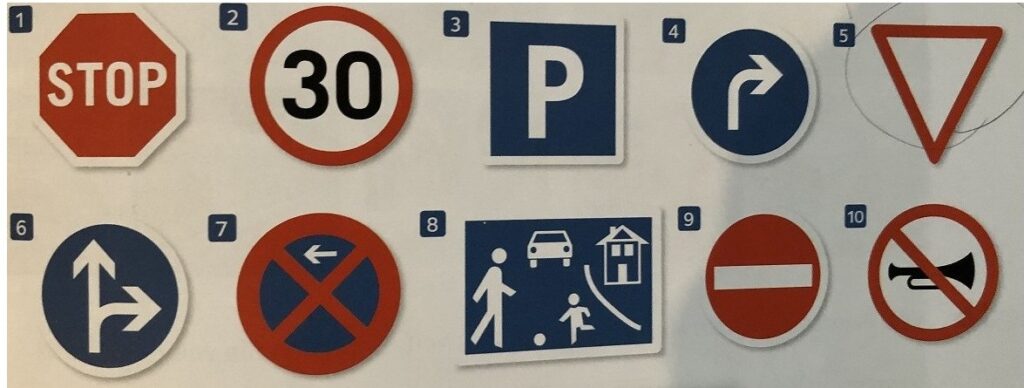
If you see an inverted white triangle, also known as a yield sign, it means that your road has lower priority.
It does not require you to come to a complete stop, but you should slow down and carefully check both directions before entering the intersection.
At roundabouts, vehicles already circulating inside the roundabout generally have priority, and a yield sign is commonly placed at the entrances.
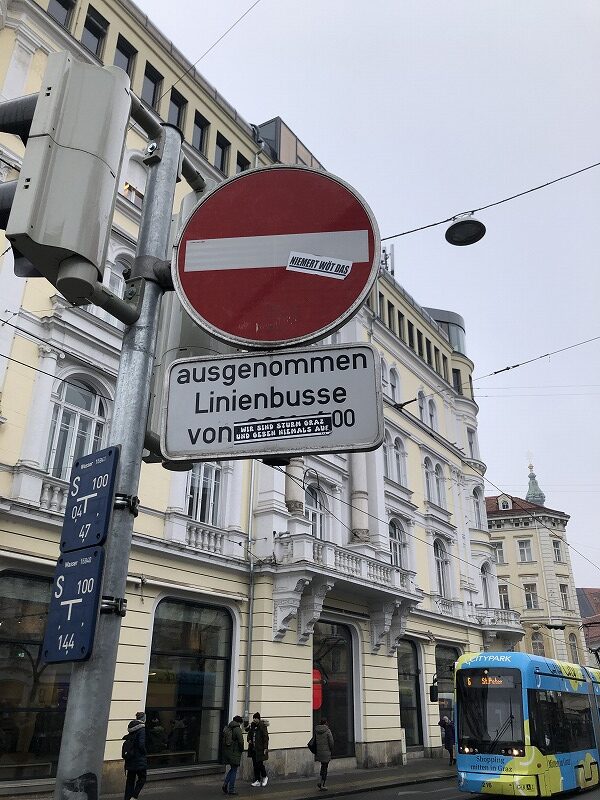
Also, be careful with the following no-entry sign. Vehicles other than public transportation such as trams and buses are prohibited from entering.
Priority to Vehicles Coming from the Right
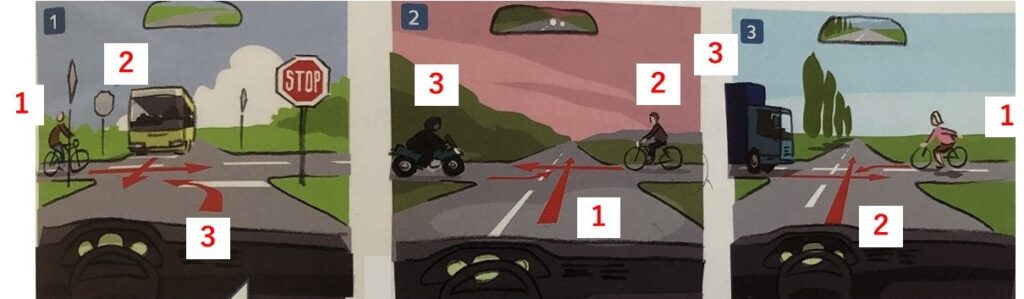
At intersections where there are no traffic lights or priority signs, vehicles approaching from the right have priority in many European countries.
This can be quite difficult to judge when you are unfamiliar with the rule, but it is most commonly applied on smaller urban streets and in low-speed areas. Because speed limits are generally low in such areas, the roads are designed to allow drivers to respond safely if they proceed carefully.
Motorways and Road Tolls
Unlike Japanese expressways, European motorways often do not have toll gates. In some cases, you may suddenly find that the speed limit has changed to 130 km/h as you enter a motorway.
In Austria, motorways require a toll, and you need a vignette, either as a physical sticker or through digital registration. If you do not purchase one in advance at a gas station or online, you may face a substantial fine.
Some rental car and car-sharing services may already include motorway tolls. For example, the tim car-sharing service I introduced recently includes Austrian motorway tolls, so you do not need to purchase a separate vignette.
Turn Signals and Windshield Wipers
One of the things Japanese drivers often find most confusing is the position of the turn-signal and windshield-wiper controls.
In many European cars, the turn signal is operated using the left-hand stalk, which is the opposite of what many Japanese drivers are accustomed to. As a result, accidentally activating the windshield wipers when trying to signal a turn is something of a “Japanese driver classic.”
However, this is not a traffic rule but a difference in vehicle design depending on the manufacturer and model, so it does not apply to every car.
One useful way to remember it is to think of the turn signal as moving in the same direction as the steering wheel movement. This can help you get used to it relatively quickly.
Conclusion|What Matters Most for Safe Driving in Europe
Driving in Europe can be described as “simple once you understand it, but dangerous if you do not.” Rules such as the town-name sign indicating a 50 km/h limit, priority to vehicles coming from the right, and priority rules at roundabouts are very different from what Japanese drivers are used to. Knowing these rules in advance can make a huge difference in how comfortable and confident you feel behind the wheel.
Enforcement of speed limits is also very strict, and even a small lapse in attention can quickly result in a fine. Rather than thinking, “Everyone else is driving faster, so it must be fine,” I believe the most important approach is to drive according to the signs and traffic rules.
At the same time, once you understand the system, European roads can actually feel quite logical and relatively stress-free because speed limits and priority rules are clearly defined. When driving for the first time, I recommend having a local person accompany you if possible, or starting in an area with lighter traffic until you become comfortable with the local rules.
Driving in Europe is more than just a way to get from one place to another—it can greatly expand your freedom and mobility in everyday life. Learn the rules, put safety first, and enjoy your European road trips.
(当ブログの記事をまとめたポータルページはここです)
(オンラインショップを始めてみました。是非こちらからご覧になってください。)
Amazon.co.jp
あなたと一緒に作る海外旅行【トラベル・スタンダード・ジャパン】


コメント